

Sleep regression ages arrive quietly. Then they happen at night with no warning. One week your child sleeps fine. However, the next week you are awake at 2 AM. You wonder what changed. Parents do not imagine this shift. Sleep regression ages are real. Furthermore, they follow patterns tied to brain growth. They are connected to movement and feelings. Many families experience sleep regression ages during summer activities. This happens because routines loosen. Daylight lasts longer. Consequently, rest time becomes inconsistent.
Understanding sleep regression ages is the best sleep advice a parent can receive. This is more likely when you are very tired and cannot think clearly. Sleep regression ages do not mean failure. Instead, they signal healthy development. Sleep regression ages are temporary. They feel endless, but they pass. Keeping the same rest time helps everyone feel better.
Sleep regression ages and why your child sleep suddenly feels broken
Sleep regression ages are times when a child’s sleep suddenly changes or gets worse.
This happens because their brain and body are growing, even though it can feel exhausting for parents.

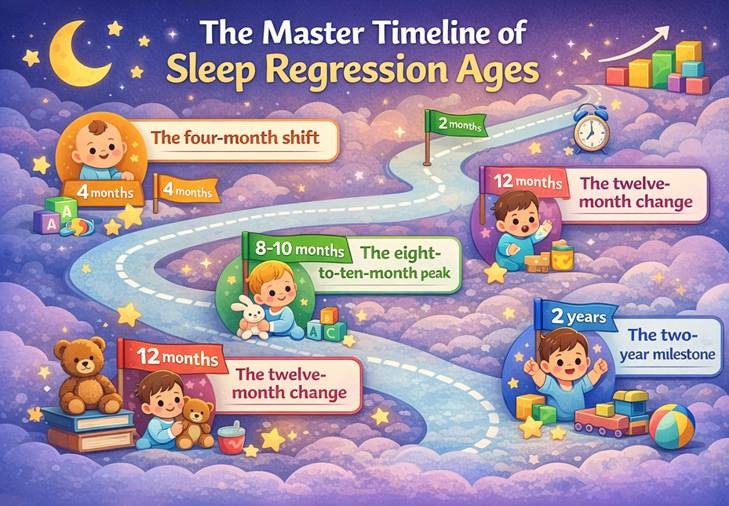
The Master Timeline of Sleep Regression Ages
The four-month shift This is where sleep regression ages begin for many families. At this stage, sleep patterns become more settled. Therefore, sleep cycles change. Babies wake more often. They struggle with self-soothing during these shifts.
The eight-to-ten-month peak Movement explodes now. This includes crawling, standing and cruising. Sleep regression ages here often bring short nights. They cause broken rest time. They lead to resistance to little naps. To manage this, parents often seek sleep coaching strategies.
The twelve-month change of dropping naps too early is common. Sleep regression ages around one year often involve waking up early mornings. Additionally, they cause confusion around nap timer schedules. Following the best sleep advice means sticking to the clock.
The eighteen-month hurdle Independence grows. Children may suddenly feel more scared of being apart. Consequently, sleep regression ages feel emotional and messy. During this phase, self-soothing becomes an important skill to help your child calm themselves.
The two-year milestone Language bursts and preschool milestones overlap. Sleep regression ages here can feel behavioural. However, they are rooted in brain development. They link to child care transitions. As a result, you may need to reset your nap timer.
Is This Really Sleep Regression Ages or Something Else?
Parents often blame everything on sleep regression ages. However, observation matters. Good child care means noticing patterns. Do not react emotionally. For instance, check if they wake up early due to light.
Common signs include:
- Frequent night waking.
- Resisting little naps.
- I suddenly woke up early in the morning.
- Difficulty returning to sleep without self-soothing.
Sleep regression ages often look worse during summer. This is because outdoor play increases stimulation. Meanwhile, rest time shortens. This should be done calmly and without panic. For example, teething or hunger can mimic sleep regression ages. Trusted child care guidance reminds parents to observe first. Sometimes, sleep coaching can provide a new perspective.

Navigating Sleep Regression Ages Without Losing Your Mind
Consistency remains the best sleep advice across all sleep regression ages. Changing everything at once creates confusion. Therefore, this helps your child feel calm and secure.
Self-soothing matters deeply. Teaching self-soothing does not mean ignoring a child. Rather, it means giving the brain space. The brain must relearn sleep cycles during sleep regression ages. The environment helps more than parents expect. Light, sound and temperature shape rest time success.
Additionally, a nap timer becomes critical. Without a nap timer, children nap too long. Or they skip little naps entirely. This worsens sleep regression ages. It leads to waking up early. Effective sleep coaching often starts with small, simple changes in the environment.

Age Specific Survival Guides for Sleep Regression Ages
Infants and early sleep regression ages Swaddles end. Movement begins. Therefore, self-soothing skills need gentle support. This is often the best sleep advice for new parents.
Toddlers are learning boundaries, so predictable rest time matters more than length. Moreover, sleep regression respond to routine consistency. If they wake up early, keep the room dark.
As preschoolers grow more independent, preschool milestones like toilet learning can trigger sleep regression ages. In addition, preschool milestones can lead to bad dreams. Changes in child care can make stress feel bigger for children. This happens even when children like their preschool milestones.
When Child Care Support and Sleep Coaching Become Helpful
Some families move through sleep regression smoothly. Others struggle. However, that does not reflect parenting quality. Professional sleep coaching can help. This is true when wake up early mornings last for weeks.
Furthermore, sleep coaching helps by watching patterns in a clear way. If little naps stop completely, sleep coaching can help guide what to do next. Child care professionals often notice preschool milestones that parents may miss.
Paediatric guidelines say rest time should stay the same during changes. Indeed, seeking help is sometimes the best sleep advice a parent can accept.

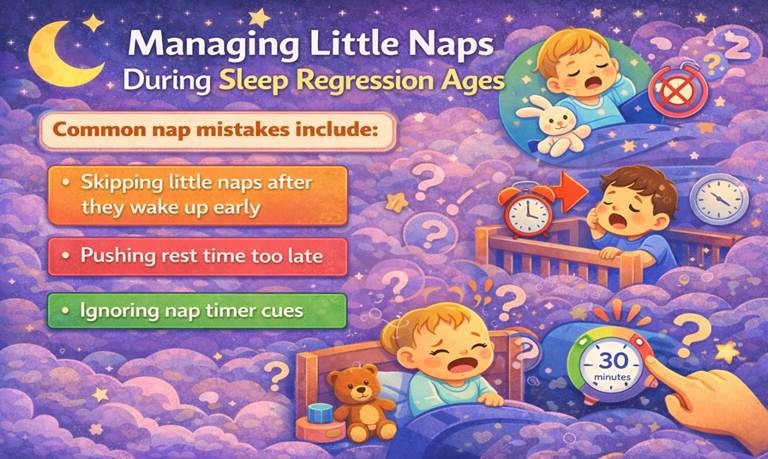
Managing Little Naps During Sleep Regression Ages
Little naps are tricky. During sleep regression, short naps feel necessary. Yet, they can ruin nights. Thus, using a nap timer is essential to track sleep.
Common nap mistakes include:
- Skipping little naps after they wake up early.
- Pushing rest time too late.
- Ignoring nap timer cues.
A nap timer protects sleep pressure. Adjusting nap timer windows slowly helps reset sleep regression. Remember, even short naps provide necessary brain breaks.
Summer Activities and Sleep Regression Ages
Summer activities bring joy. They also bring overstimulation. Longer daylight delays melatonin. Consequently, excitement shortens rest time.
Sleep regression ages during summer feel more intense. This is because routines loosen. Nevertheless, experts recommend protecting rest time during holidays. This is the best sleep advice for travel. Keeping summer activities balanced with regular little naps helps avoid problems, even if kids wake up early.
The Emotional Side of Parenting
Sleep regression ages affect adults deeply. Exhaustion changes patience. Moreover, waking up early every morning can cause frustration. Parents feel unsure about themselves.

Remember this: sleep regression do not reflect failure. Instead, they reflect growth and new preschool milestones. Developing self-soothing skills takes time. Preschool milestones come with temporary sleep chaos. Little naps fluctuate. None of these lasts forever.
Final Thoughts on Sleep Regression Ages
Sleep regression always pass. They arrive loudly and leave quietly. Each phase strengthens the brain. Therefore, the best sleep advice is patience.
Child care is not about perfection. It is about observation and trust. If summer activities disturb rest time, slow things down gently. Use a nap timer. Protect little naps. Support self-soothing. Finally, remember that sleep regression are not bad. They simply show that your child is growing and developing well.
FAQs
1. How long do sleep regression ages usually last?
Most sleep regression last 2 to 6 weeks. With consistent rest time and routines, many children settle sooner.
2. Do sleep regressions happen to every child?
Not every child shows obvious signs. However, most children experience at least one sleep regression age linked to brain or movement growth.
3. Can sleep regression cause wake up early mornings?
Yes. Wake up early mornings are very common during sleep regression, especially when naps or bedtime shift.
4. Should I change my child’s schedule during sleep regression?
No major changes are recommended. The best sleep advice is to keep rest time and nap timer schedules consistent.
5. When should parents consider sleep coaching?
If broken sleep, skipped little naps, or wake up early mornings last longer than a few weeks, sleep coaching can help identify patterns calmly.
Hi there to every one, the contents existing at this site are
truly amazing for people knowledge, well, keep up the good work fellows.
I every time used to read paragraph in news papers but now as I am a user
of web thus from now I am using net for content, thanks to web.
It’s difficult to find well-informed people for this subject, but you seem like you know what you’re talking about!
Thanks
Hello just wanted to give you a quick heads up.
The text in your post seem to be running off the
screen in Ie. I’m not sure if this is a formatting issue or something to do with browser compatibility but
I thought I’d post to let you know. The design look great though!
Hope you get the problem resolved soon. Thanks
My spouse and I stumbled over here coming from a different web page and thought I should check things out.
I like what I see so now i am following you. Look forward to
looking over your web page again.
Hello, I log on to your blog daily. Your humoristic style
is witty, keep up the good work!
Thanks on your marvelous posting! I genuinely enjoyed
reading it, you may be a great author.I will remember to bookmark your
blog and will eventually come back in the future.
I want to encourage you continue your great job, have a nice evening!
Thank you for the good writeup. It in fact was a amusement account it.
Look advanced to more added agreeable from you!
However, how can we communicate?
This is a topic that is close to my heart… Cheers! Where
are your contact details though?
WOW just what I was looking for. Came here by searching for
free apps log in to reply
Attractive section of content. I just stumbled upon your website and in accession capital to assert that I acquire actually enjoyed
account your blog posts. Any way I’ll be subscribing
to your augment and even I achievement you access consistently quickly.
It’s wonderful that you are getting ideas from this post as
well as from our dialogue made here.
Great weblog here! Also your website so much up very fast!
What host are you the usage of? Can I am getting your
associate hyperlink to your host? I wish my website loaded up as fast as yours lol
Hi, I do think this is an excellent blog. I stumbledupon it 😉 I
will come back once again since i have bookmarked it.
Money and freedom is the best way to change, may you be rich and continue to help others.
It’s going to be ending of mine day, but before
end I am reading this fantastic post to increase my experience.
Hello there! I know this is kinda off topic but I was wondering if you knew where I could locate
a captcha plugin for my comment form? I’m using the same blog platform as yours and I’m having difficulty finding
one? Thanks a lot!
Heya i’m for the first time here. I came across this board and I find It really useful & it helped me out a lot.
I hope to give something back and aid others like you aided
me.
Hello there, I found your web site by means of Google at the
same time as searching for a similar topic, your site
came up, it looks great. I’ve bookmarked it in my google bookmarks.
Hello there, just become aware of your weblog via Google,
and located that it’s really informative.
I am going to watch out for brussels. I’ll appreciate in case you proceed this in future.
Numerous folks will be benefited from your writing.
Cheers!
Hi, I do believe this is an excellent blog. I stumbledupon it 😉 I
may come back once again since i have book marked it. Money
and freedom is the greatest way to change, may you be rich
and continue to help others.
It’s a shame you don’t have a donate button! I’d most certainly donate to this
superb blog! I suppose for now i’ll settle for book-marking
and adding your RSS feed to my Google account. I look forward to fresh updates and will share
this blog with my Facebook group. Talk soon!
An impressive share! I have just forwarded this onto a colleague who
had been conducting a little research on this. And he
in fact bought me dinner simply because I stumbled upon it for him…
lol. So allow me to reword this…. Thank YOU for the meal!!
But yeah, thanx for spending time to discuss this topic here on your web
site.
I am sure this post has touched all the internet visitors, its
really really nice post on building up new weblog.
I’m not that much of a internet reader to be honest but your sites really nice, keep it
up! I’ll go ahead and bookmark your site to come back down the
road. Many thanks
I always used to study post in news papers but now as I am a user of web thus from
now I am using net for content, thanks to web.
There’s definately a lot to learn about this subject. I love all the points
you have made.
Good day I am so glad I found your web site, I really found you by accident, while I
was searching on Askjeeve for something else, Anyhow I am here now and would just like
to say kudos for a fantastic post and a all round thrilling blog (I also love the theme/design),
I don’t have time to browse it all at the moment but I have saved it and
also added your RSS feeds, so when I have time I will be
back to read a great deal more, Please do keep up the fantastic work.
I think that is among the such a lot significant info for
me. And i am happy studying your article. But want to observation on some normal things, The site taste is wonderful, the articles is in point of fact nice : D.
Good task, cheers
This design is wicked! You definitely know how to keep a reader amused.
Between your wit and your videos, I was almost moved to
start my own blog (well, almost…HaHa!) Wonderful job.
I really loved what you had to say, and more than that, how you presented it.
Too cool!
I am extremely impressed with your writing skills as well as with the
layout on your blog. Is this a paid theme
or did you modify it yourself? Anyway keep up the excellent quality writing, it’s rare to see a great blog like this one
today.
Thanks for every other great article. The place else could
anyone get that kind of info in such a perfect means of writing?
I have a presentation next week, and I am on the look for such information.
Asking questions are truly fastidious thing if you are not understanding
anything fully, but this paragraph provides
nice understanding yet.
Asking questions are in fact fastidious thing if you are not
understanding something entirely, except this paragraph gives good understanding even.
Excellent blog! Do you have any recommendations for aspiring
writers? I’m hoping to start my own site soon but I’m a little lost
on everything. Would you advise starting with a free platform
like WordPress or go for a paid option? There are so
many options out there that I’m completely overwhelmed .. Any suggestions?
Appreciate it!
Thanks for ones marvelous posting! I certainly enjoyed reading it, you’re a great author.
I will ensure that I bookmark your blog and definitely will come back later in life.
I want to encourage you to definitely continue your great job, have a nice afternoon!
An outstanding share! I have just forwarded this onto a co-worker who had been doing a
little homework on this. And he in fact bought me breakfast because I found it for him…
lol. So allow me to reword this…. Thank YOU for the
meal!! But yeah, thanks for spending the
time to discuss this matter here on your web page.
Wonderful website you have here but I was curious about if you knew of
any discussion boards that cover the same topics talked about in this article?
I’d really love to be a part of online community where I can get comments from other
experienced people that share the same interest. If you have
any suggestions, please let me know. Thanks!
Everything is very open with a precise description of the challenges.
It was truly informative. Your site is useful. Thanks for
sharing!
I’m really enjoying the theme/design of your blog.
Do you ever run into any browser compatibility issues?
A number of my blog audience have complained about my website not working correctly in Explorer but looks great
in Opera. Do you have any ideas to help fix this problem?
These are in fact wonderful ideas in concerning
blogging. You have touched some good factors here.
Any way keep up wrinting.
Hurrah! In the end I got a web site from where I can actually obtain helpful data
concerning my study and knowledge.
I am in fact thankful to the holder of this web page who has shared this great
article at here.
Hi, its fastidious post on the topic of media print, we
all understand media is a enormous source of data.
Hello, I enjoy reading through your article.
I like to write a little comment to support you.
I really like what you guys are usually up too.
Such clever work and reporting! Keep up the excellent works
guys I’ve you guys to blogroll.
I do consider all the concepts you’ve presented in your post.
They are very convincing and will definitely work.
Nonetheless, the posts are too brief for starters. Could you please extend them
a bit from next time? Thanks for the post.
Good day! I just wish to give you a big thumbs up for the
great info you have got right here on this post. I’ll be returning to
your website for more soon.
I every time used to study paragraph in news papers but
now as I am a user of net thus from now I am using net for content, thanks to web.
After going over a few of the articles on your blog, I honestly like your technique of writing a blog.
I book-marked it to my bookmark site list and
will be checking back soon. Please visit my website
too and let me know how you feel.
Incredible quest there. What occurred after?
Take care!
Wow, superb blog format! How lengthy have you been running a blog for?
you made blogging glance easy. The entire glance of your website is wonderful,
as neatly as the content material!
Hi there to every one, it’s really a fastidious for me to go
to see this site, it includes helpful Information.
I’m gone to convey my little brother, that he
should also pay a visit this weblog on regular basis to get updated from most recent news.
You really make it seem so easy with your presentation but I find
this topic to be actually something which I think I
would never understand. It seems too complex and extremely broad for me.
I’m looking forward for your next post, I’ll try to get the hang of it!
Terrific article! That is the type of information that are meant to be shared around the internet.
Shame on Google for no longer positioning this post higher!
Come on over and visit my web site . Thank you =)
Hi to every body, it’s my first pay a quick visit
of this blog; this website includes awesome and genuinely
good material designed for readers.
Hey there! I’m at work browsing your blog from my new iphone!
Just wanted to say I love reading through your blog and look forward
to all your posts! Carry on the great work!
Today, I went to the beach front with my kids. I found a sea shell and gave it to
my 4 year old daughter and said “You can hear the ocean if you put this to your ear.”
She placed the shell to her ear and screamed.
There was a hermit crab inside and it pinched her ear. She never wants to go back!
LoL I know this is totally off topic but I had to tell
someone!
There’s certainly a lot to learn about this topic.
I like all of the points you have made.
Great beat ! I would like to apprentice while you amend your web site,
how can i subscribe for a blog web site? The account helped me a acceptable deal.
I had been tiny bit acquainted of this your broadcast provided bright clear idea
Asking questions are in fact pleasant thing if you are not understanding something entirely, however
this paragraph gives nice understanding even.
I am really loving the theme/design of your website.
Do you ever run into any web browser compatibility problems?
A handful of my blog visitors have complained about my site not working correctly in Explorer but looks great in Firefox.
Do you have any tips to help fix this issue?
I’m not sure where you are getting your info, but great topic.
I needs to spend some time learning more or understanding more.
Thanks for magnificent information I was looking for this info for my mission.
It’s difficult to find educated people in this particular topic, however, you sound like
you know what you’re talking about! Thanks
Howdy just wanted to give you a quick heads up. The words in your content seem to be running off the
screen in Chrome. I’m not sure if this is a formatting issue or something to do with internet browser compatibility but I thought I’d post
to let you know. The layout look great though! Hope you get the problem resolved soon.
Many thanks
I was extremely pleased to discover this great site. I want to to thank
you for ones time for this particularly wonderful read!!
I definitely liked every bit of it and i also have you saved as a favorite to check out new information on your web
site.
Excellent post. I was checking constantly this blog and I am impressed!
Very helpful info particularly the last part 🙂 I care
for such information much. I was looking for this
particular information for a long time. Thank you
and good luck.
Hello Dear, are you in fact visiting this web page regularly, if so after that you will absolutely obtain pleasant know-how.
Yesterday, while I was at work, my cousin stole my apple ipad
and tested to see if it can survive a 30 foot drop,
just so she can be a youtube sensation. My apple ipad is now
broken and she has 83 views. I know this is entirely off topic but I had to share it
with someone!
Hi, yes this piece of writing is truly nice and I have
learned lot of things from it regarding blogging. thanks.
It’s an amazing paragraph in favor of all the internet viewers; they will take advantage from it
I am sure.
That is really fascinating, You are an excessively skilled blogger.
I have joined your rss feed and sit up for in the hunt for extra of your magnificent post.
Also, I have shared your web site in my social networks
Excellent website you have here but I was wanting to know if you knew of any message boards that cover the
same topics discussed here? I’d really love to be a part of online community
where I can get feed-back from other knowledgeable people that share the same interest.
If you have any recommendations, please let me know.
Thanks!
Wonderful work! This is the kind of info that should be shared around
the net. Shame on Google for now not positioning this submit upper!
Come on over and seek advice from my site . Thanks =)
I need to to thank you for this fantastic read!!
I certainly enjoyed every bit of it. I’ve got you book-marked to look at new things you post…
WOW just what I was searching for. Came here by searching for
tips kesehatan leave a comment
I was recommended this website by my cousin. I’m not sure whether
this post is written by him as no one else know such detailed about my problem.
You are incredible! Thanks!
I every time emailed this web site post page to all my contacts, as if like to read
it next my contacts will too.
Terrific post however I was wondering if you could write a litte more on this topic?
I’d be very thankful if you could elaborate a little bit further.
Cheers!
It’s genuinely very complicated in this full
of activity life to listen news on TV, therefore I just use internet for
that purpose, and get the newest information.
Aw, this was an incredibly nice post. Taking a few minutes and actual effort
to generate a good article… but what can I say… I hesitate a lot and never manage
to get anything done.
You actually make it seem so easy with your presentation but I find this matter
to be actually something which I think I would never understand.
It seems too complex and very broad for me. I’m looking forward
for your next post, I will try to get the hang of it!
Hello every one, here every person is sharing such knowledge, therefore it’s pleasant to read this website, and I
used to pay a quick visit this blog everyday.
Fantastic beat ! I would like to apprentice while you amend your web site, how could i subscribe for a blog site?
The account helped me a acceptable deal. I were a little
bit acquainted of this your broadcast provided vibrant transparent idea
I know this if off topic but I’m looking into starting my own blog and was curious
what all is needed to get setup? I’m assuming
having a blog like yours would cost a pretty penny? I’m not very web smart so I’m not 100% sure.
Any tips or advice would be greatly appreciated. Thank you
Good blog post. I certainly appreciate this website.
Keep writing!
I’m gone to tell my little brother, that he should
also pay a visit this weblog on regular basis to get updated from most recent reports.
Hi there very nice website!! Man .. Beautiful .. Amazing ..
I’ll bookmark your site and take the feeds additionally?
I’m satisfied to search out numerous helpful info here in the submit, we’d like develop extra
strategies in this regard, thank you for sharing.
. . . . .
You really make it seem so easy with your presentation but I find
this topic to be really something that I think I would never understand.
It seems too complicated and very broad for me.
I am looking forward for your next post, I will try
to get the hang of it!
Hi I am so delighted I found your site, I really
found you by accident, while I was searching on Bing for something else, Anyways I am here now and would just like
to say thanks a lot for a fantastic post and
a all round interesting blog (I also love the theme/design), I
don’t have time to read it all at the moment but I have book-marked it and also added in your RSS feeds, so when I have time I will be back to read a lot more, Please do keep
up the great b.
My spouse and I stumbled over here coming from a different page and thought I should check things out.
I like what I see so now i’m following you. Look forward to checking out your web page yet again.
It’s in fact very complex in this busy life to listen news on Television, so I only use world wide
web for that purpose, and take the hottest news.
Heya i’m for the first time here. I found this board and I
find It truly useful & it helped me out
much. I hope to give something back and aid
others like you helped me.
Hi! I just wanted to ask if you ever have any issues with hackers?
My last blog (wordpress) was hacked and I ended
up losing several weeks of hard work due to no data backup.
Do you have any solutions to protect against hackers?
Hello there, just became alert to your blog through Google,
and found that it is really informative. I’m going to watch out
for brussels. I’ll appreciate if you continue this in future.
Numerous people will be benefited from your writing.
Cheers!
Currently it appears like WordPress is the top blogging platform out there right now.
(from what I’ve read) Is that what you’re using on your blog?
Hi, I do believe this is a great site. I stumbledupon it 😉 I am
going to return yet again since I book marked it. Money
and freedom is the best way to change, may you be rich and continue to guide
others.
What’s up mates, how is everything, and what you would like to say concerning this
paragraph, in my view its in fact awesome in support of
me.
Pretty great post. I just stumbled upon your weblog and wanted to mention that I’ve
truly loved browsing your blog posts. After all I will be
subscribing to your rss feed and I’m hoping you write again soon!
Nice blog here! Also your site loads up fast! What web host are you using?
Can I get your affiliate link to your host? I wish my website
loaded up as quickly as yours lol
WOW just what I was looking for. Came here
by searching for bisnis online berikan komentar
This is a very good tip particularly to those fresh to the blogosphere.
Simple but very accurate information… Many thanks for sharing this one.
A must read article!
You’ve made some really good points there. I looked on the net to learn more
about the issue and found most individuals will go along with your views on this web site.
Very great post. I just stumbled upon your blog and wanted to mention that I’ve really loved surfing around your
weblog posts. In any case I’ll be subscribing on your feed and I am hoping you write again soon!
Hi, i feel that i noticed you visited my site thus i came to go back the favor?.I am attempting to to find things to enhance my website!I
guess its good enough to make use of a few of your ideas!!
Very nice post. I just stumbled upon your weblog and wanted
to say that I have truly enjoyed surfing around your blog posts.
After all I will be subscribing to your rss feed and I hope
you write again very soon!
Good day! I simply would like to give you a huge
thumbs up for your great info you have got right
here on this post. I’ll be coming back to your blog for more soon.
Hello are using WordPress for your blog platform? I’m new to the blog world but I’m trying
to get started and create my own. Do you need any html
coding knowledge to make your own blog? Any help
would be really appreciated!
I like what you guys tend to be up too. This sort of clever work
and exposure! Keep up the amazing works guys I’ve included
you guys to my personal blogroll.
Way cool! Some very valid points! I appreciate you writing this article and also the rest of the site is extremely good.
This piece of writing will help the internet
visitors for building up new weblog or even a weblog from start to end.
It’s a pity you don’t have a donate button! I’d without a doubt donate to this brilliant blog!
I guess for now i’ll settle for book-marking and adding your RSS feed to my
Google account. I look forward to fresh updates and will talk about this blog with my Facebook
group. Talk soon!
Fantastic goods from you, man. I have take into account your stuff prior to and you’re simply extremely
excellent. I really like what you’ve obtained right here,
certainly like what you’re saying and the way during which you are saying it.
You’re making it enjoyable and you continue to take care of to stay it sensible.
I cant wait to learn much more from you.
This is actually a terrific website.
Neat blog! Is your theme custom made or did you download it
from somewhere? A theme like yours with a few simple
adjustements would really make my blog shine. Please let me know where you got your design. Thanks a lot
Thanks for another wonderful article. Where else may anybody get that kind of
info in such a perfect way of writing? I have a presentation next week, and I’m
on the look for such info.
Howdy! I simply wish to give you a big thumbs up for the excellent info
you have right here on this post. I will be returning to your web site for more soon.
Hey are using WordPress for your site platform?
I’m new to the blog world but I’m trying to get started and create my own. Do you require any coding knowledge to
make your own blog? Any help would be really appreciated!
Hello there! I know this is kind of off topic but I was wondering if you
knew where I could get a captcha plugin for my comment form?
I’m using the same blog platform as yours and I’m having problems finding one?
Thanks a lot!
Quality posts is the key to invite the people to pay a quick visit the
website, that’s what this web site is providing.
Write more, thats all I have to say. Literally, it seems as though you relied on the
video to make your point. You clearly know what youre talking
about, why throw away your intelligence on just posting videos to your site
when you could be giving us something informative
to read?
After looking at a number of the blog posts on your blog, I honestly like your
way of blogging. I book-marked it to my bookmark site list and will be checking back in the near future.
Please check out my web site as well and tell me your opinion.
whoah this weblog is excellent i like reading your articles.
Stay up the good work! You already know, many people are searching round for this info, you could help them greatly.
Its like you read my mind! You seem to know a lot about this, like you wrote the book in it
or something. I think that you can do with a few pics
to drive the message home a little bit, but other than that, this is magnificent blog.
An excellent read. I will definitely be back.
My brother recommended I might like this blog. He was totally right.
This post actually made my day. You can not imagine just how much time
I had spent for this information! Thanks!
Hello to every , because I am actually keen of reading this website’s
post to be updated regularly. It consists of pleasant
data.
Howdy! This is my first visit to your blog! We are a team of
volunteers and starting a new project in a community in the same niche.
Your blog provided us beneficial information to work on. You have done a marvellous
job!
First off I would like to say terrific blog!
I had a quick question in which I’d like to ask if you do not mind.
I was curious to find out how you center yourself and clear your
mind prior to writing. I’ve had a hard time clearing
my mind in getting my ideas out. I do take pleasure in writing however
it just seems like the first 10 to 15 minutes are
wasted simply just trying to figure out how to begin. Any ideas
or tips? Thank you!
This piece of writing will help the internet viewers for building up new website
or even a blog from start to end.
Thank you for the auspicious writeup. It in fact was a amusement account it.
Look advanced to far added agreeable from you!
By the way, how could we communicate?
That is very interesting, You are a very professional blogger.
I have joined your feed and look ahead to searching for more of
your wonderful post. Also, I have shared your site in my social networks
Thanks for sharing your thoughts on tutorial komputer add new comment.
Regards
I am sure this piece of writing has touched all the internet visitors, its really really good post on building up new website.
It’s actually a great and useful piece of info.
I’m glad that you shared this helpful information with us.
Please keep us up to date like this. Thank you for sharing.
You actually make it seem so easy with your presentation but
I find this topic to be actually something which I think I would never understand.
It seems too complicated and extremely broad for me. I’m looking forward
for your next post, I will try to get the hang of it!
wonderful issues altogether, you just won a brand new reader.
What may you suggest in regards to your publish that you just made some days ago?
Any sure?
This is my first time pay a visit at here and i am in fact impressed to
read all at alone place.
If some one desires to be updated with newest technologies afterward he
must be go to see this website and be up to date every day.
Hey there would you mind letting me know which webhost
you’re utilizing? I’ve loaded your blog in 3 different internet browsers and I must say this blog loads a lot quicker then most.
Can you suggest a good web hosting provider at a fair price?
Kudos, I appreciate it!
Hello! Do you know if they make any plugins to help
with Search Engine Optimization? I’m trying to get my blog to
rank for some targeted keywords but I’m not seeing very good
results. If you know of any please share. Thank
you!
Good day! This is my first comment here so I just wanted to give a quick shout out and tell you I really enjoy
reading your blog posts. Can you recommend any other blogs/websites/forums that cover
the same subjects? Appreciate it!
I was recommended this blog by my cousin. I’m not sure whether this post
is written by him as nobody else know such detailed about
my difficulty. You’re incredible! Thanks!
I got this web page from my friend who shared with me about this web site and at the moment this time I am browsing this web page and
reading very informative articles at this place.
Hurrah! At last I got a website from where I can in fact
obtain valuable information regarding my study and knowledge.
Woah! I’m really digging the template/theme of this blog.
It’s simple, yet effective. A lot of times it’s tough to get that “perfect balance” between user friendliness and visual appeal.
I must say you’ve done a awesome job with this. Additionally,
the blog loads extremely fast for me on Internet explorer.
Excellent Blog!
Hi, its nice article on the topic of media print, we all know media is
a enormous source of data.
Right away I am going to do my breakfast, afterward having my breakfast coming over again to read
more news.
Wow, amazing blog layout! How long have you been blogging for?
you make blogging look easy. The overall look of your
web site is fantastic, let alone the content!
Thanks for the good writeup. It actually used to be a leisure account it.
Glance complex to far brought agreeable from you! By the way,
how can we communicate?