
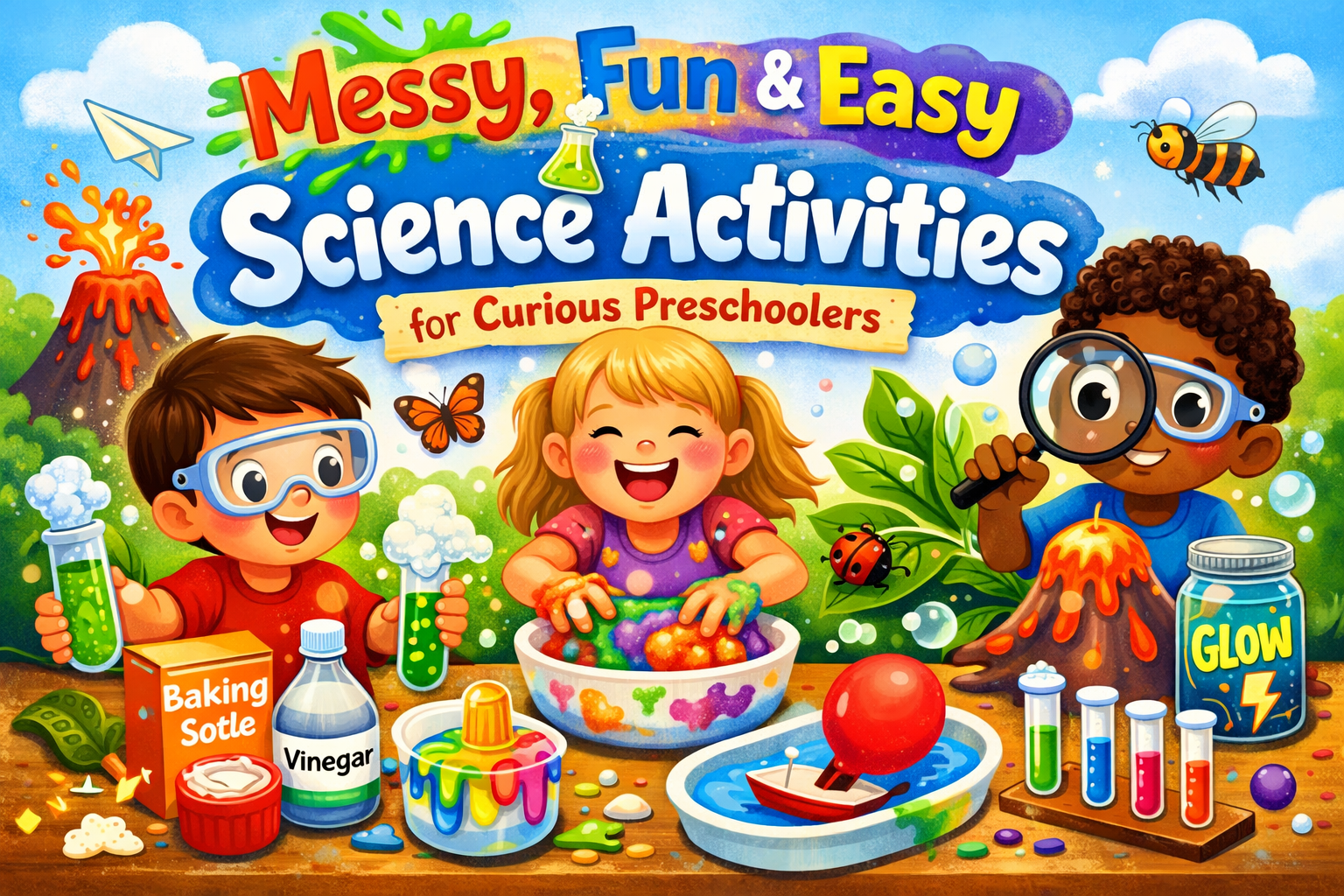
Easy science activities for preschoolers offer the perfect way to spend a rainy afternoon or a busy morning. If a four-year-old child is nearby then the word why is likely their favourite thing to say. They want to know why the sky is blue and why the water disappears when it boils. Consequently, it is important to give them answers through discovery-based learning. It simply means children learn best when they get a little messy.
STEM for preschoolers can be simple and low-cost with easy science activities. When discovery-based learning is used it helps these little humans build critical thinking. Resilience grows because things do not always work out the first time in a lab.
Why Every Parent Needs Easy Science Activities for Preschoolers

Every parent and teacher needs easy science activities for preschoolers because brain development is wild. When kids engage in science experiments for kids they stimulate neural pathways. Therefore, linking preschool education activities to fine motor skills is vital. Classroom connections are clear when play aligns with kindergarten activities. Consequently, easy science activities for preschoolers provides a foundation for future education activities.
Homemade science experiments use kitchen staples. Doing science experiments for kids creates bonds. Discovery based learning works best when adults step back. Preschool education activities are about the process. Many childcare activities keep kids busy, but easy science activities for preschoolers keep them thinking. If kindy activities happen formally or at home. Kindergarten activities thrive on curiosity. Discovery based learning transforms education activities into play. Childcare activities become meaningful with homemade science experiments. Using kindy activities ensures preschool education activities remain fun. Kindergarten activities lead to success.
The Top 10 Easy Science Activities for Preschoolers
Let us jump into the top ten easy science activities for preschoolers. This list ensures that preschool education activities are top tier for every child.
Magic Milk Color Burst
First, there is the Magic Milk Color Burst. This is a great example of homemade science experiments. One needs milk and some soap to see surface tension in action. It is one of those easy science activities for preschoolers that looks like magic. In reality, it is actually just cool physics.
- Start by adding a thin layer of whole milk into a shallow dish or plate.
- Then, add several drops of different food coloring into the center of the whole milk.

- Dip a cotton swab into liquid dish soap and touch the colors.
- Watch as the colors “burst” away from the soap across the plate.

The Sink or Float Challenge
Next is the Sink or Float Challenge. This is one of the most essential education activities for a simple plastic tub. One finds random toys and guesses if they will sink or float. This is how discovery-based learning starts early on.
- Start by filling a large transparent container or a plastic tub with water.
- After that collect a few household objects like a metal spoon, a cork and a toy car.
- Ask the child to predict whether each item will stay on top or sink.
- Drop each item into the water and talk about why some items sink.

Baking Soda and Vinegar Volcanoes
Kids really like baking soda and vinegar volcanoes. They get messy and loud Consequently, kids love it every single time. This kind of preschool education activities teaches about chemical reactions in a way they can actually see.
- Place a small cup or bottle in a tray to catch the mess.
- Drop two tablespoons of baking soda to the bottom of the container.
- Add food coloring into a cup of white vinegar.
- Slowly pour the vinegar into the container and watch it fizz.

Walking Water Rainbow
Number four is the Walking Water Rainbow. This uses paper towels to show capillary action. It is a slow but beautiful part of discovery-based learning. Furthermore, it is a favourite among education activities for showing how colors blend.
- Place six cups in a circle, filling every other cup with water.
- Add red, yellow, and blue food coloring to the water-filled cups.
- Fold paper towel strips and place them between the cups like bridges.
- Wait as the water “walks” over the bridges to create new colors.

Rain Cloud in a Jar
For number five, there is the Rain Cloud in a Jar. This helps with visualizing saturation during childcare activities. It helps children see weather as something fun instead of scary. This makes it a common activity in easy science activities for preschoolers.
- Fill a glass jar almost to the top with clean water.
- Squirt a thick layer of shaving cream on top to act as a cloud.
- Mix blue food coloring with a little water in a separate small bowl.
- Use a pipette to drop the blue water onto the cream until it “rains.”

Celery Water Absorption
Number six is Celery Water Absorption. This is a long-term observation project for preschool education activities. It takes a day or two, but watching the leaves change color is worth it and helps children learn patience through simple science activities.
Trim the bottom of a few fresh celery stalks that still have leaves.
- Place each stalk into a separate glass filled with water.
- Add a generous amount of food coloring to each glass of water.
- Observe over 48 hours as the colored water travels up the stem.

Dancing Raisins
Number seven is Dancing Raisins. In this case, CO2 bubbles make fruit jump around. This is one of those really engaging kindy activities. It is another homemade science experiment that uses basic kitchen items.
Fill a clear glass with a fresh bottle of lemon-lime soda.
- Drop several raisins into the glass and watch them sink.
- Wait for the carbon dioxide bubbles to attach to the raisin skins.
- Watch the raisins float to the top, pop their bubbles and sink again.

Magnetic Scavenger Hunt
For number eight, there is the Magnetic Scavenger Hunt. This is one of those active kindergarten activities that gets them moving around the house. This discovery-based learning task helps kids identify different materials.
- Give the child a strong magnet or a magnetic wand.
- Ask them to find ten things in the room that the magnet sticks to.
- Encourage them to test wood, plastic and different types of metal.
- Discuss why some metals are magnetic while other materials are not.

Oil and Water Discovery Bottles
Number nine involves Oil and Water Discovery Bottles. These are mess free homemade science experiments that even toddlers can enjoy. They work well in childcare because everything stays inside.
Fill a clean plastic bottle halfway with ordinary vegetable oil.
- Fill the rest of the bottle with water and add food coloring.
- Close the lid tightly and seal it with glue or strong tape.
Let the child shake the bottle and watch the liquids separate.

Shadow Drawing and Sun Tracking
Finally, number ten is Shadow Drawing and Sun Tracking. These are perfect outdoor easy science activities for preschoolers. Children learn about the sun and the earth. This learning activity is better outdoors on a sunny day. Put a large sheet of paper on the ground in direct sunlight.
- Set a toy animal or a tall object at one end of the paper.
- Use a pencil to trace the shape of the shadow on the paper.
- Return every hour to trace the shadow again and see how it moved.

How to Facilitate Education Activities Like a Pro
The key to education activities is how they are facilitated. One needs to ask the right questions to make easy science activities for preschoolers truly effective. Instead of saying look at that, one should ask what is seen. Similarly, ask what might happen next. Setting up a lab is also important when organizing childcare activities. This helps to minimize the cleanup later. Use only non-toxic materials for homemade science experiments. keep towels nearby during kids’ science experiments. This is important just in case things get splashy.
Preschool education activities are more about the conversation than the mess. Discovery based learning happens when the child feels safe to fail. Bath time can become a science activity with bubbles and cups. Snack time can also turn into simple food experiments.

Integrating Science into Daily Kindy Activities
These lessons should flow naturally into everything. Kindergarten activities are most successful when they feel like play rather than work. If discovery-based learning is used throughout the day then the children will become natural observers. Education activities are everywhere if one looks for them.
Childcare activities should be more than just watching kids play. Homemade science experiments can happen during lunch or during outdoor play. Because curiosity is natural easy science activities for preschoolers are always a hit.

Conclusion: Nurturing the Next Generation of Scientists
Easy science activities for preschoolers are a gift to children. These simple science experiments stay in their memories for a long time. Try homemade science experiments today and watch the learning come alive.
Preschool education activities will never be the same again. Embrace discovery-based learning in everything. Make education activities count. Childcare activities will be transformed. Kindergarten activities will be full of life. Enjoy kindy activities and keep asking why.
Happy experimenting with easy printable easy science activities for preschoolers.
FAQ: Everything You Need to Know About Easy Science Activities for Preschoolers
What are the most popular easy science activities for preschoolers?
They are usually the activities that make a little mess.
How does discovery-based learning benefit early childhood?
It builds a sense of wonder.
What supplies are needed for homemade science experiments?
One needs vinegar baking soda and food colouring.
Are these education activities suitable for a classroom setting?
Absolutely, they work in a classroom or a home kitchen. Science experiments for kids help them understand the world. Preschool education activities should be accessible to everyone. Kindy activities thrive on simple materials. Kindergarten activities are better with science.