

Colors for preschool are often the first structured learning experience children have. Kids meet it without knowing they are learning. Colors for preschool appear quietly during play. They show up at snack time and come up on walks outside. It happens in art moments. These colors help children sort the world they see. Colors for preschool go beyond naming shades. They guide young minds to group objects. It help store facts. They build meaning through repetition. When families explore colors for preschool together, learning feels safe and familiar. It does not feel like school.
Colors for preschool link straight to learning colors through daily contact. A child learns colors by pointing. They learn by touching. Kids compare. They repeat. Learning colors gets stronger when fundamental colors arrive slowly and in a natural way. Fundamental colors bring clarity. They stop confusion. Studies in childhood education show that colors for preschool serve as an early bridge. This bridge joins language and thought.
The science of sight in childhood education
This section explains how seeing and naming colors helps young brains develop key skills.
How learning colors supports memory improve
Learning colors supports memory improve. It builds the brain’s skill to hold visual labels. When kids see red often and hear “red” said in a calm voice, memory improve begins quietly. Soon, memory improve helps them name colors without help. This tie between colors for preschool and memory improve matters a lot in childhood education. Because learning colors repeats in many places, memory improve turns steady. It no longer depends on the situation.
Observation skills grow through visual focus
Observation skills start when children stop seeing everything at once. Instead, they spot small differences. Colors for preschool sharpen observation skills. They push kids to compare. A blue cup and a green cup now seem different. Observation skills get stronger when basic colors sit next to each other. Basic colors let children slow their eyes. In childhood education settings, observation skills rise when teachers use colors for preschool on purpose.
Hand coordination develops through color interaction
Hand coordination gets better when children touch, grab, stack, and sort colored items. Colors for preschool support hand coordination in a natural way during play. Hand coordination grows when artistic play adds reaching, squeezing, and painting. Childhood education spaces often add colorful activities. These activities build hand coordination without any pressure.
Starting with fundamental colors and basic colors
This section covers why and how to begin with simple, clear colors for the best start.
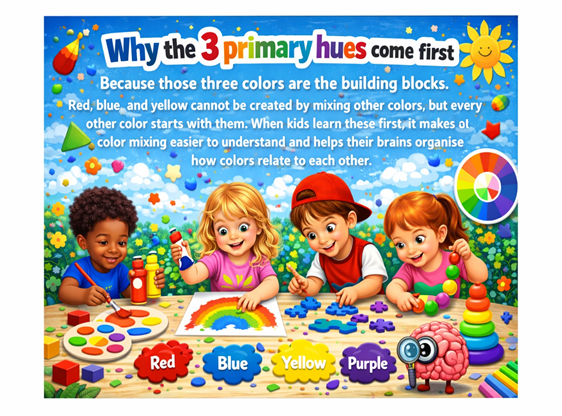
Why do the 3 primary hues come first
The 3 primary hues form the base for all other colors. Colors for preschool start best with the 3 primary hues. They stand out clearly. Red, yellow, and blue make learning colors feel easy to predict. Fundamental colors stop sensory overload. In childhood education, the 3 primary hues let children gain confidence first. They build it before secondary colors come.
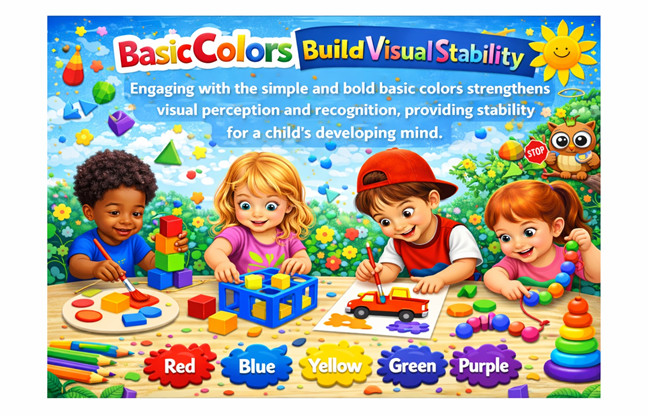
Basic colors build visual stability
Basic colors help children hold onto meaning. Colors for preschool feel easy to handle when basic colors repeat in toys, books, and art. Learning colors turns simpler when basic colors show up in daily objects. When we pair fundamental colors with words, memory improve grows in a natural way.
Avoiding overload in early learning
Too many colors at once can mix up young learners. Colors for preschool work best when fundamental colors appear many times first. After that, add secondary colors bit by bit. Childhood education research points to the power of slow steps. It stresses basic colors at the start.
Artistic play and a visual art approach
This section shows how creative activities make learning colors fun and meaningful.
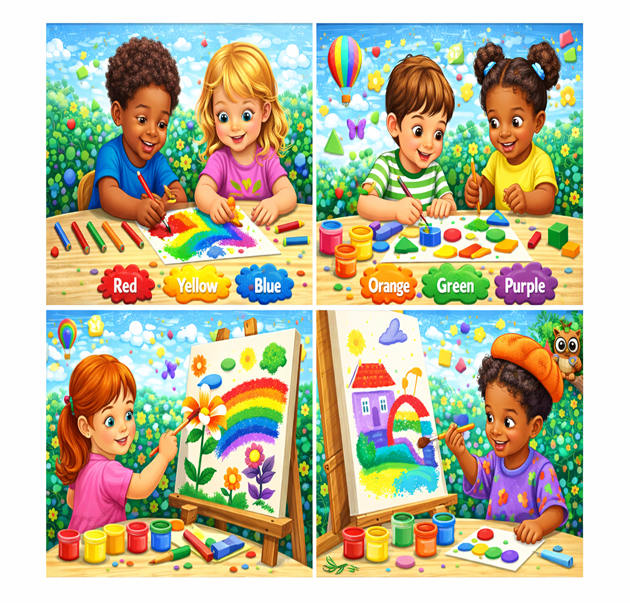
Artistic play supports learning colors naturally
Artistic play lets children try colors without fear of mistakes. Colors for preschool do well inside artistic play. Learning colors turns fun when kids mix, smear, and try new things. Artistic play helps memory improve by repeating actions. Childhood education experts often praise artistic play. They call it a top learning tool.
A visual art experience builds meaning
A visual art experience changes color learning into discovery. Colors for preschool stick in mind when children make something of their own. A visual art experience boosts observation skills. It shows change and new forms. Secondary colors show up in a natural way through mixing. Learning colors feels exciting. It does not feel like a lesson.
Secondary colors through exploration
Secondary colors emerge when children try things out. Colors for preschool grow richer when secondary colors arrive slowly. Artistic play helps children watch how secondary colors form. Observation skills grow deeper in this way. Secondary colors spark visual curiosity.
Colorful activities at home and school
This section shares simple daily activities that help reinforce color learning.
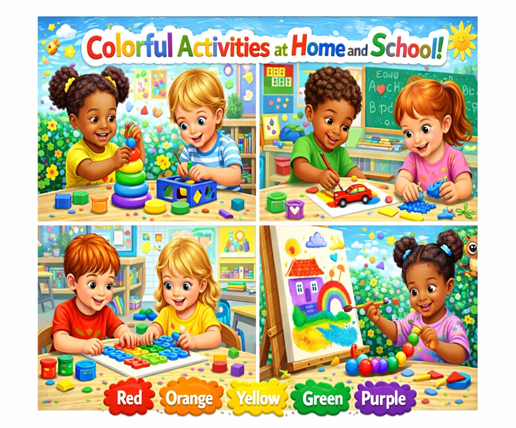
Colorful activities reinforce learning
Colorful Activities help learning colors through movement and repetition. Colors for preschool become routine when Colorful Activities happen every day. Childhood education programs often use Colorful Activities. They reinforce ideas without worksheets.
• Sorting games using basic colors
• Matching objects using fundamental colors
• Art time with artistic play
Repetition strengthens memory improve
Repetition helps memory improve when colors for preschool show up often. Learning colors takes place during meals, playtime, and outdoor walks. Memory improves builds through familiar things. When we place Colorful Activities all through the day, memory improve stays steady.
Tactile learning and hand coordination
Playdough, sand, and paint build hand coordination. Colors for preschool paired with touch boost hand coordination in a natural way. Childhood education spaces use tactile Colorful Activities. These activities strengthen observation skills and memory improve at the same time.
Troubleshooting learning challenges
This section offers gentle advice for when color learning feels slower or harder.
Every child learns at their own pace
Colors for preschool grow differently in every child. Learning colors can take time. Childhood education knows that observation skills build step by step. Memory improves changes from child to child. This is normal.
Supporting observation skills gently
High contrast materials help observation skills. Colors for preschool stand out more when backgrounds stay neutral. Learning colors feels less hard when we cut visual clutter.
When professional guidance helps
If learning colors stays hard for a long time, talking to a professional can help. Childhood education experts can guide families in a calm way.
Conclusion building confidence through colors for preschool
This final section wraps up the importance of a relaxed, joyful approach to colors.
Colors for preschool are not about being perfect. Colors for preschool bring structure, curiosity, and comfort. Learning colors opens doors to reading, math, and problem solving. Fundamental colors and basic colors set the base. Secondary colors bring creativity. Artistic play keeps learning full of joy. A visual art approach builds memory improve, observation skills, and hand coordination. Childhood education does best when Colorful Activities feel natural and supportive.
When families’ welcome colors for preschool in daily moments, children grow confident. They feel sure about how they see and describe the world.
Frequently Asked Questions (FAQ)
What are the best colors for preschool to start with?
Start with the three primary hues: red, yellow and blue. These fundamental colors are clear and easy for young kids to learn first.
How do colors for preschool help memory improve?
Kids see and hear the same color names over and over. This repetition helps the brain store and recall colors easily.
Why is artistic play good for learning colors?
Artistic play lets children mix and explore colors in a fun way. There is no pressure, so learning feels like play.
What if my child struggles with learning colors?
Every child learns at their own pace. It is normal. Use high contrast items and keep it gentle. If it lasts a long time, talk to a childhood education expert.
How can I add colorful activities at home?
Try simple sorting games with basic colors. Match everyday objects. Add art time with paint or playdough. Repeat these often during daily routines.